You turn the key on a cold morning and for about three seconds the front of the engine sounds like a bag of marbles in a clothes dryer. Then it goes quiet and idles like nothing happened.
If you drive a 5.4 Triton 3-valve, you already know what that is. And if you’ve been telling yourself it’s just “a Ford thing” and it’ll be fine, this article is for you, because that noise is the beginning of a conversation about several thousand dollars.
The good news is that catching it early changes the size of the bill quite a lot.
What a cam phaser actually does
Skip this if you already know. Here’s the plain version.
The 3V engine can change its valve timing while it’s running. At idle it wants one setting, at 4,000 rpm pulling a trailer it wants another. To do that, Ford put a device called a cam phaser on the end of each camshaft. The phaser is basically a hydraulic coupling that lets the camshaft rotate slightly ahead of or behind the timing chain.
What moves it is engine oil. A solenoid meters oil pressure into the phaser, the phaser twists a few degrees, the computer watches a sensor to confirm it got there.
Which means the entire system depends on clean oil at the right pressure. That’s the whole story of why these fail.
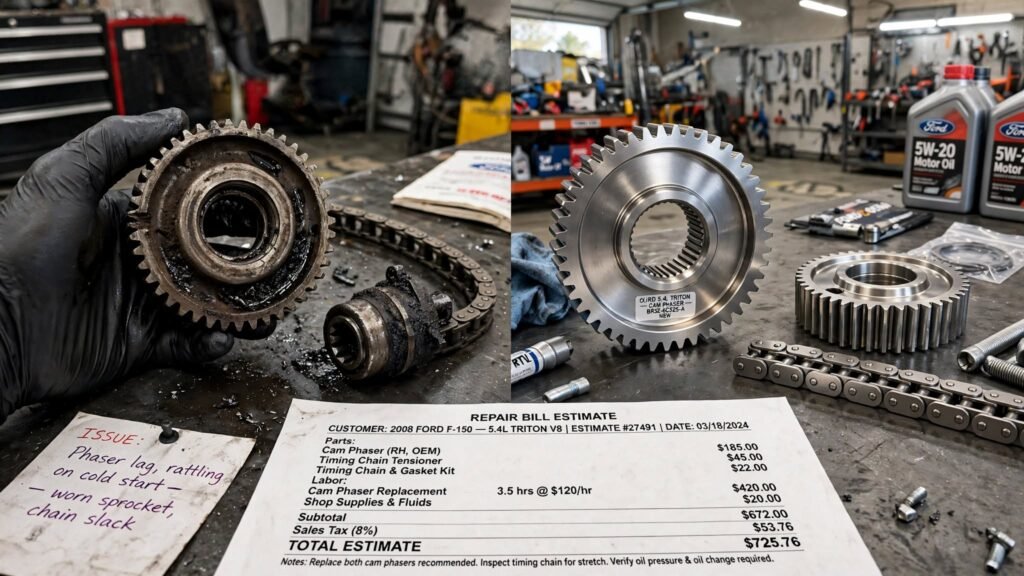
When the engine is off, a small spring-loaded lock pin holds each phaser in its home position so it can’t flop around. On a worn phaser, that pin doesn’t hold. On start-up, before oil pressure builds, the phaser rattles against its stops. Three seconds later oil arrives, everything locks up, and the noise stops.
That’s your rattle.
Symptoms, from “keep an eye on it” to “stop driving”
Rattle for 1–3 seconds on cold start, then silence. Early-stage phaser wear. Nothing is broken yet. This is the moment to change your oil habits and start saving.
Rattle that lasts longer, or shows up when the engine is warm. Wear has progressed. Oil pressure is no longer enough to control the phasers properly. Get it diagnosed.
A ticking or knocking that rises and falls with engine speed. Could be the phasers, could be timing chain slap from stretched chains and tired guides, could be an exhaust manifold leak or a cam follower. Needs a real diagnosis, not a guess from a forum post.
Rough idle, hesitation, or a stumble off the line. The phasers are stuck somewhere they shouldn’t be and valve timing is wrong. Usually comes with a check engine light. Worth ruling out a vacuum leak first, though — it produces a very similar rough idle and stumble on these engines, but throws P0171 and P0174 instead of phaser codes. Our guide to the 5.4 Triton vacuum hose diagram covers how to tell the two apart.
Noticeable power loss, especially under load. Timing is retarded far enough that the computer has pulled everything back. Towing feels awful.
Metal in the oil filter. Stop. This isn’t a phaser conversation anymore, it’s a “what else has this damaged” conversation.
The codes you’ll see
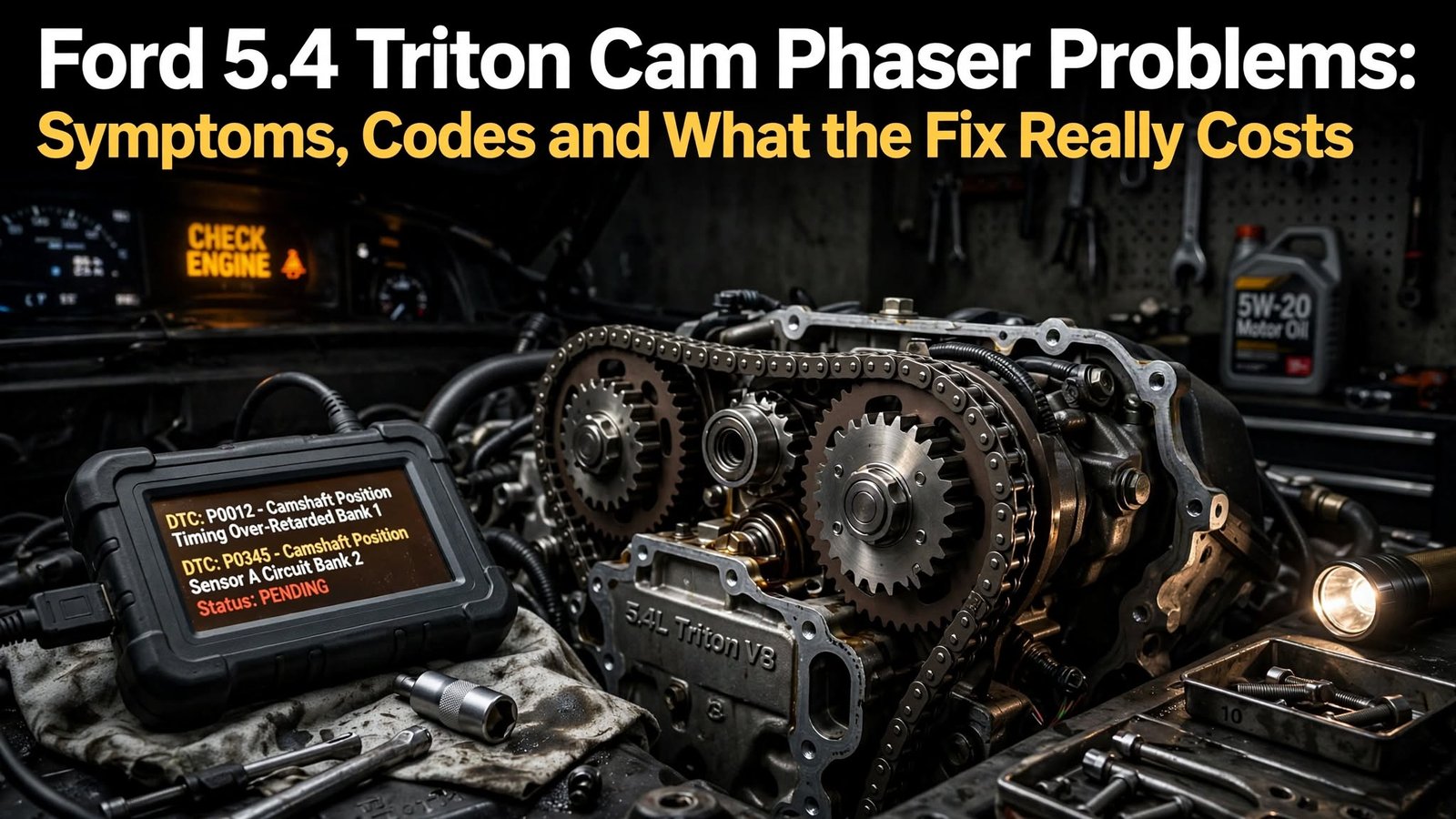
If the light is on, a $30 reader will tell you a lot:
- P0011 / P0012 – camshaft position timing over-advanced or over-retarded, bank 1
- P0021 / P0022 – same thing, bank 2
- P0016 / P0019 – crankshaft and camshaft position correlation. This one leans toward stretched timing chains, not just phasers.
- P000A / P000B – camshaft position slow response
- P0340 / P0345 – camshaft position sensor circuit
One important thing: these codes don’t automatically mean “buy phasers.” They mean the cam isn’t where the computer told it to be. A clogged VCT solenoid screen, a failing solenoid, low oil pressure from a worn pump, or a sensor problem can all set the same codes for a fraction of the price. A good shop checks those first. A lazy one quotes you the full timing job on day one.
Why they fail
It’s oil. It’s almost always oil.
Extended oil change intervals. The 3V asks for 5W-20 and it means it. Oil that’s been in there 10,000 miles has lost its viscosity control and carries enough debris to plug the tiny screens in the VCT solenoids. Starve a phaser of clean pressure and it wears.
Wrong viscosity. People put 5W-30 or heavier in these because “thicker is safer.” It isn’t. The phaser oil passages were designed around 5W-20, and thicker oil slows response, especially cold.
Sludge. Neglected 3Vs build varnish in the front of the engine. Once the passages are restricted, no amount of new oil fixes it quickly.
Age and mileage. Even a well-maintained one can get rattly past 150,000 miles. The lock pins and the phaser bores just wear.
Timing chain stretch. The chains, guides and tensioners age alongside the phasers. This is why the repair is usually done as one job rather than piece by piece.
Which engines this affects
Mainly the Ford 3-valve modular engines:
- 5.4L 3V – F-150 2004–2010, Expedition and Navigator 2005–2014, gas Super Duty 2005–2010
- 4.6L 3V – F-150 2009–2010, Mustang 2005–2010
- 6.8L V10 3V – Super Duty and E-Series
The 5.4 2-valve engine, found in 1997–2003 F-150s and later vans, has no variable cam timing at all. No phasers, no phaser rattle. If you’re still deciding which 5.4 to buy, that difference matters. We broke the whole thing down here: Ford 5.4 Triton Years to Avoid (And the Ones Actually Worth Buying).
What the repair costs
Prices swing hard depending on where you live and who does the work, but here’s a realistic picture.
| Job | Parts | Typical shop total |
|---|---|---|
| VCT solenoids only | $60–$150 | $250–$450 |
| Phasers only | $300–$600 | $1,200–$2,000 |
| Phasers + chains + guides + tensioners | $600–$1,200 | $1,800–$3,200 |
| Same job at a dealer | — | $2,500–$4,500 |
The parts are not what’s expensive. The labor is. Getting to the phasers means coming in through the front of the engine, and on a 4×4 with the engine in the truck it’s a long day even for someone who’s done a dozen of them. Most shops quote somewhere between 10 and 16 hours.
If you’re doing it yourself, budget a full weekend, buy the cam holding tools, and do the chains while you’re in there. Going back in six months to do the timing set because you only replaced the phasers is the single most common regret on this job.
Can you just keep driving it?
For a while, yes. Plenty of these trucks rattle on cold start for years and never leave anyone stranded.
But you’re rolling dice on two things. First, a phaser that comes apart can drop debris into the front of the engine. Second, phaser wear travels with chain and guide wear, and a chain that jumps a tooth on a 5.4 can bend valves. That’s no longer a $2,000 repair, that’s an engine.
Practical middle ground: if it’s a short cold-start rattle and nothing else, switch to fresh 5W-20 every 5,000 miles, use a quality filter, and watch it. If the rattle gets longer, the light comes on, or you feel it in how the truck drives, book the job.
The lockout kit question
You’ll see cam phaser lockout kits online for a couple hundred dollars. They bolt the cams into a fixed timing position and delete the variable timing entirely.
They do work. Racers and high-mileage work-truck owners use them, and they permanently remove the failure point.
The catches: you need a custom tune afterward or the computer will throw codes forever and run badly, you lose some low-end torque and some fuel economy, and the engine has to come apart anyway to install it. So you’re doing 90% of the labor of a proper repair for a result that isn’t quite stock.
If the truck is a beater that hauls things and you never want to think about phasers again, it’s a defensible choice. If it’s a daily driver you want to feel normal, do it properly with updated OEM-spec parts.
How to not end up here
- 5,000-mile oil changes, 5W-20, no exceptions. This is the whole prevention plan. Everything else is a footnote.
- Use a decent filter. The filter is what protects those solenoid screens.
- Don’t ignore an oil pressure gauge that reads lower than it used to.
- Fix oil leaks. A truck that’s always a quart low is a truck with a phaser problem in its future.
- Let it idle a few seconds before driving off cold. Not a cure, but it’s free.
Frequently asked questions
How long can I drive with a rattling cam phaser?
There’s no safe number. Some go years, some fail in months. The variable that matters is whether the timing chains and guides are also worn, and you can’t tell that from outside the engine.
Will thicker oil quiet the rattle?
It sometimes masks it for a few thousand miles and it makes the underlying problem worse. The system was engineered for 5W-20.
Is it the phasers or the timing chain?
Overlapping symptoms, and by the time one is bad the other usually is too. P0016 and P0019 point more toward chain stretch. Either way, the repair is the same trip into the engine, which is why it’s normally done together.
Can new spark plugs or solenoids fix cam phaser codes?
Solenoids, sometimes. A clogged or failing VCT solenoid will absolutely set P0012 or P0022, and it’s a cheap thing to rule out first. Spark plugs, no.
Did Ford ever fix this?
The later 3V engines, roughly 2009 onward, got updated phaser and timing components and are noticeably less prone to it. Not immune, but better.
Bottom line
A three-second rattle on a cold morning is your engine telling you something early and politely. Answer it with clean 5W-20 every 5,000 miles and honest monitoring, and plenty of these trucks go another 100,000 miles.
Answer it by turning the radio up, and the next conversation is about timing chains.