

You start the truck, and there’s a bang like a gunshot from under the hood. The engine sounds like the exhaust has blown apart, it idles rough, and it barely pulls in gear. If you own a Ford with the 5.4 Triton V8, you have almost certainly just ejected a spark plug out of the cylinder head.
It is one of the most notorious faults in modern Ford history, and it has caught out thousands of F-150, Expedition, Excursion and E-Series owners. The good news is that it is repairable, often without pulling the head, and it is preventable once you understand why it happens.
What a Spark Plug Blowout Actually Is
The spark plug threads into the aluminium cylinder head. On the affected Triton engines, there simply is not enough thread holding it in place. Combustion pressure inside the cylinder pushes against the plug thousands of times a minute, and eventually the aluminium threads give way.
Once they do, the plug is fired out of the head like a cork. It takes the threads with it, and it usually destroys or breaks the mounting ear on the ignition coil sitting on top.
Symptoms of a Blown-Out Spark Plug
- A sudden loud pop, bang or ticking from the engine bay
- A noise that sounds like a hole in the exhaust
- Immediate rough running and a heavy misfire
- Noticeable power loss, especially under acceleration
- Check engine light, usually with a misfire code for the affected cylinder
The engine will be running on seven cylinders instead of eight. If you hear this, shut it down. Driving on it risks further damage to the head and the coil.
Which Years Are Affected? There Are Two Different Problems
This is where most articles get it wrong. The 5.4 Triton has two separate spark plug faults, and which one you get depends on your model year.
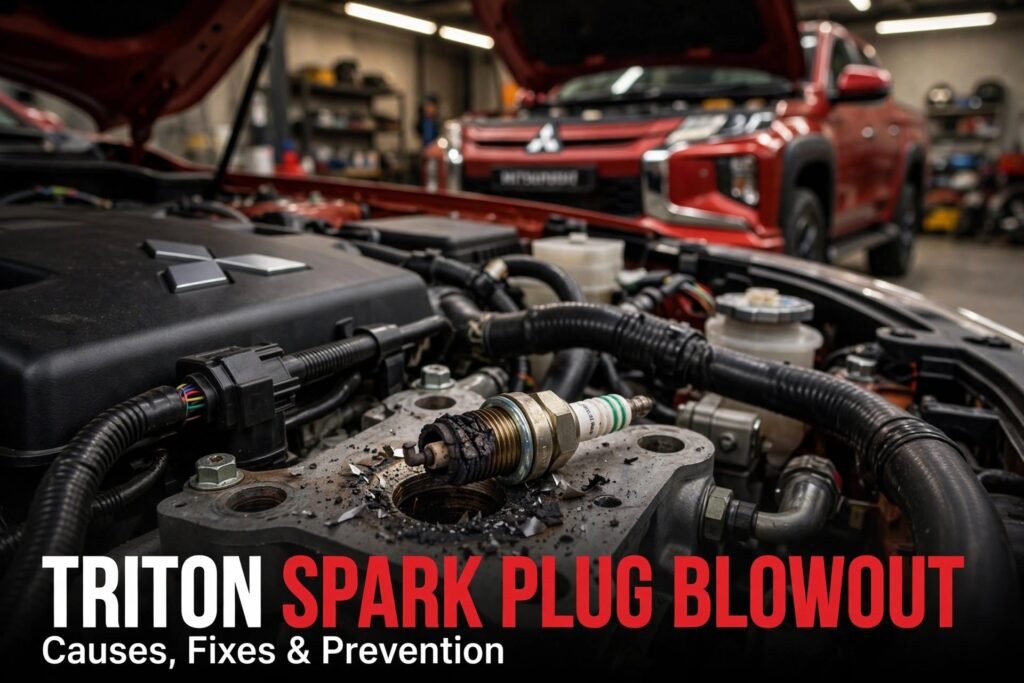
1997–2003: The Blowout Problem (2-Valve Heads)
Early 5.4 Triton heads used only about four aluminium threads to hold each spark plug. That is not enough thread engagement for the combustion pressure involved, and plugs began ejecting themselves.
Blowouts typically show up between 60,000 and 100,000 miles, a pattern also flagged in technician service bulletins covering these trucks. Cylinders 2, 3 and 4 are the most commonly reported, and rear plugs on the passenger side are frequent offenders.
2004 and Later: The Broken Plug Problem (3-Valve Heads)
From 2003 Ford revised the heads with roughly eight threads, which largely solved the ejection issue. But the 3-valve engines that followed use a two-piece spark plug design that is notorious for something else entirely: breaking apart during removal and leaving the lower portion stuck in the cylinder head.
Ford issued service guidance covering 2004–2005 F-150 and 2005 F-Super Duty, Expedition and Navigator models with the 5.4L 3-valve engine, acknowledging difficulty with spark plug removal that can damage the plug and leave part of it in the head.
If you are shopping for a 5.4 rather than fixing one, this split is the whole decision — our guide to Ford 5.4 Triton years to avoid breaks down which model years carry which risk.
| Model Years | Head Type | Main Risk |
|---|---|---|
| 1997–2003 | 2-valve, ~4 threads | Spark plug ejection / blowout |
| 2004 onwards | 3-valve, ~8 threads | Two-piece plug breaking off in the head |
Post-2003 engines are far less prone to blowouts, but it is not impossible — there are documented cases. Fewer, not none.
Which Vehicles Use the 5.4 Triton?
The 5.4 was a workhorse across Ford’s line-up. You will find it in:
- Ford F-150 and F-Series Super Duty
- Ford Expedition
- Ford Excursion
- Ford E-Series vans
- Lincoln Navigator
The related 4.6L and 6.8L modular engines share the same basic design and can suffer the same problem.
How to Fix a Blown-Out Spark Plug
You cannot simply thread a new plug into a stripped hole. The aluminium threads are gone and need to be rebuilt.
Thread Repair Inserts
The standard repair is a steel thread insert fitted into the damaged hole. The two approaches you will hear about:
- Time-Sert — a solid bushing that many technicians consider the stronger, more permanent fix
- Heli-Coil — a coiled wire insert, widely used and well proven when installed carefully
Both are available as kits designed specifically for Ford modular engines, and in most cases the repair can be done with the head still on the vehicle. That is what keeps the cost sane.
Doing It Without Pulling the Head
The critical part is keeping metal chips out of the cylinder. Experienced technicians pack the tap with heavy grease so the shavings stick to it rather than falling into the engine, work slowly, and clear the tap repeatedly.
Rushing this step is how a straightforward repair becomes an engine rebuild. The sequence most technicians follow:
- Confirm which cylinder failed. Scan for the misfire code, and look for a coil sitting out of place or a plug missing entirely.
- Let the engine cool completely and disconnect the battery. Cutting threads in a hot aluminium head invites trouble.
- Remove the coil and clear the hole. Extract the ejected plug, any broken fragments, and the damaged coil boot.
- Rotate the engine so that piston sits at the top of its travel. This closes off most of the path debris could take into the cylinder.
- Pack the tap with heavy grease. Aluminium shavings stick to the grease instead of dropping into the engine. This is the single most important habit in the whole job.
- Cut the new threads slowly. Back the tap out repeatedly, wipe it clean, re-grease, and go again. Do not power through it.
- Vacuum the hole thoroughly before anything else goes in.
- Install the thread insert following the specific instructions supplied with your Time-Sert or Heli-Coil kit.
- Fit a new plug. Use a Motorcraft plug, apply anti-seize sparingly to the threads, and torque it with a wrench to the figure in your service manual.
- Replace the damaged coil and boot, reconnect the battery, clear the codes, and run the engine to confirm the misfire is gone.
If any step is beyond your tooling — particularly the chip control — hand it to a shop that has done it before. The repair itself is routine; the consequences of getting metal into a cylinder are not.
How to Stop It Happening Again
Nearly every blowout traces back to one of three things: worn threads, an overdue plug change, or incorrect installation torque.
Torque the Plugs Properly
This is the big one. The correct torque figure for these engines is much lower than most people assume, and tightening by feel is the single most common way owners cause their own blowout. Use a torque wrench and use the exact figure from the service manual for your specific year and engine — do not guess, and do not go by what worked on a different vehicle.
Do Not Leave Plugs In Too Long
Ford recommends spark plug service on the 5.4 Triton around the 100,000-mile mark. Leaving them in well past that allows the plug to seize into the threads, which both damages the threads on removal and accelerates the loosening that leads to ejection. It also tends to kill the coils.
Check the Torque Periodically
Loose plugs are what start the failure. Periodically checking that the plugs are still at spec costs nothing and catches the problem before the threads let go.
Use the Right Plugs
Ford recommends sticking with Motorcraft plugs for these engines. Add anti-seize to the threads sparingly and do not overtighten.
What Does the Repair Cost?
Costs vary widely by region and shop, but the shape of it is predictable. A single-hole thread repair done in the vehicle is a fraction of the cost of removing the cylinder head, and dramatically cheaper than the engine replacement some owners are quoted. If a shop quotes you for a head removal on a single blown plug, get a second opinion — many experienced technicians handle this without pulling anything.
The Bottom Line
The 5.4 Triton is a genuinely durable engine that has hauled millions of miles. This one design flaw is its reputation-killer, and it is entirely manageable once you know it exists. Know which version of the fault your model year is prone to, service the plugs on schedule, and torque them with a wrench rather than an elbow.
On 3-valve engines, a plug problem often arrives alongside a rattle from the front of the engine — that one is covered in Ford 5.4 Triton cam phaser problems.
If you are working on a 5.4 and need the cylinder layout, see our guide to the firing order for 5.4 Ford engines. While you have the coils off, it is worth checking the vacuum lines too — our vacuum hose diagram for the Triton Ford 5.4 maps the whole system. And if the misfire turns out to be electrical rather than mechanical, the 2003 Ford Expedition fuse box guide covers the circuits on these same-era trucks.
Frequently Asked Questions
Which 5.4 Triton years blow out spark plugs?
Primarily 1997 through 2003, which used cylinder heads with only around four threads holding each plug. From 2003 Ford increased thread engagement substantially.
Can I drive with a blown-out spark plug?
You should not. The engine is misfiring on that cylinder, and continuing to drive risks further damage to the head threads and the ignition coil.
Do I have to remove the cylinder head to fix it?
Usually not. Most thread repairs are done with the head in place using a Time-Sert or Heli-Coil kit, provided the metal chips are controlled carefully.
Is Time-Sert or Heli-Coil better?
Time-Sert uses a solid bushing and is generally regarded as the more robust permanent repair. Heli-Coil is cheaper and works well when installed properly.
Why do 2004 and newer 5.4 plugs break instead?
The 3-valve engines use a two-piece spark plug design that can seize and separate during removal, leaving the lower section stuck in the head. That is a removal problem, not an ejection problem.
How often should 5.4 Triton spark plugs be changed?
Ford recommends service around 100,000 miles, and checking plug torque more frequently helps prevent ejection.







[…] We wrote a full breakdown of this failure, including which trucks are affected and what the repair actually involves, here: 5.4 Triton Spark Plug Blowout: Causes, Affected Years and How to Fix It. […]
Thanks for sharing this! The breakdown of the affected model years and what the repair actually involves sounds really useful for anyone dealing with the 5.4 Triton spark plug issue. We appreciate you adding this resource to the discussion.
Comments are closed.