Ask five people which years of the Ford 5.4 Triton to avoid and you’ll get five different answers. One guy says stay away from 2004 through 2008. Another swears the 2004 and 2006 trucks are the only bad ones. Your mechanic, who used to work at a Ford dealer, tells you all of them are junk and you should buy a Chevy.
They’re all sort of right and all sort of wrong, because they’re arguing about the wrong thing.
The year on the title isn’t what matters most. What matters is which version of the 5.4 is sitting under the hood, because Ford built two very different engines and gave them the same name. Once you understand that, the whole “years to avoid” question sorts itself out in about thirty seconds.
The short answer
If you want the quick version before the details:
| Years | Engine | Verdict |
|---|---|---|
| 1997–2002 | 5.4 2V | Buy with caution. Spark plug blowout risk. |
| 2003 | 5.4 2V | Good. Revised heads, far fewer blowouts. |
| 2004 (new-body F-150) | 5.4 3V | Avoid. First-year 3V, worst of everything. |
| 2005–2008 | 5.4 3V | Avoid unless the plugs and phasers are already done. |
| 2009–2010 | 5.4 3V | Best of the 3V trucks. Revised plugs and timing parts. |
| 2011–2014 (Expedition/Navigator) | 5.4 3V | Decent. Same late-3V improvements. |
That’s the cheat sheet. Now here’s why.
The part everybody skips: 2V vs 3V
The 5.4 Triton ran from 1997 all the way into the mid-2010s. Over that span Ford sold it in two main flavors, and they fail in completely different ways.
The 2-valve (2V) came first. Two valves per cylinder, no variable cam timing, no phasers, nothing clever. It’s a simple, low-stress truck motor. In F-150s it ran from 1997 to 2003, and it stuck around in E-Series vans and gas Super Dutys for years after that.
The 3-valve (3V) arrived in 2004 with the redesigned F-150. Three valves per cylinder, variable cam timing, more horsepower, better fuel economy on paper. It’s also the engine responsible for roughly 90% of the horror stories you’ve read.
Here’s the confusing part: 2004 was a split year. Ford sold the old-body F-150 alongside the new one that year and called the old one the “Heritage.” The Heritage got the 2V. The new-body 2004 F-150 got the 3V. Two trucks, same model year, totally different risk profile.
So before you look at a single listing, run the VIN through a decoder and find out which engine you’re actually looking at. It takes a minute and it’s the single most useful thing you can do.
The three ways a 5.4 takes your money
1. Spark plugs blowing out of the head (mostly 1997–2003 2V)
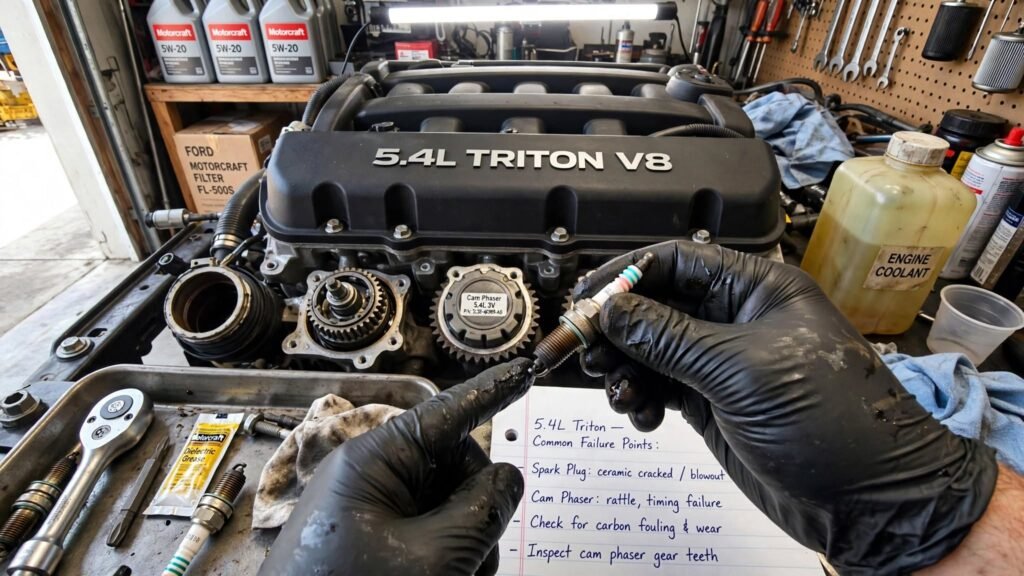
The early 2V heads are aluminum, and Ford cut the spark plug holes with only about four threads of engagement. Four threads holding back a combustion chamber. Over time, with heat cycles and a plug that was torqued a little optimistically at the factory, the threads let go and the plug launches itself out of the head with a sound you will never forget.
It usually happens at highway speed. You get a loud pop, a noise like a diesel with a hole in it, and a flashing check engine light.
The good news is it’s fixable without pulling the head. A thread insert kit (Time-Sert is the one most shops trust) puts steel threads in the hole and the repair generally outlasts the truck. Figure a few hundred dollars if a shop does one hole, more if several have gone or if the threads are torn up badly enough to need the head off.
Ford quietly revised the heads around 2003 with deeper threads. That’s why 2003 is the sweet spot of the 2V years.
We wrote a full breakdown of this failure, including which trucks are affected and what the repair actually involves, here: 5.4 Triton Spark Plug Blowout: Causes, Affected Years and How to Fix It.
2. Spark plugs snapping off inside the head (2004–2008 3V)
Different engine, different plug problem, somehow even more annoying.
The 3V used a two-piece spark plug. A normal-looking top section, and a long thin ground shield sticking down into the combustion chamber. Carbon builds up around that shield and welds it to the cylinder head. When you try to unscrew the plug, the top comes out and the bottom stays behind.
On a bad one, you’ll break six of eight. Each broken plug needs a special extraction tool and a steady hand, and a shop will charge you per plug on top of the regular job. A tune-up that should be a $300 afternoon turns into a four-figure bill.
It’s avoidable if you know the trick: warm the engine up, back each plug out a fraction of a turn, spray penetrating oil down the well, let it soak, and work it back and forth instead of forcing it. Patience is the whole technique. Ford switched to a one-piece plug design toward the end of the 3V run, which is another reason 2009–2010 trucks are easier to live with.
3. Cam phasers (3V only)
The big one. The 3V’s variable cam timing relies on two cam phasers that rely on clean oil at the right pressure. Skip oil changes, run the wrong viscosity, or just put 150,000 miles on it, and the phasers start rattling like someone dropped a fistful of bolts into the front cover.
Classic symptom: a loud rattle for one to three seconds on cold start that goes away once oil pressure comes up. That’s the early warning. Ignore it long enough and you’re into timing chains, guides, tensioners, and a repair bill in the thousands.
If you’re looking at a 3V truck, the cold start is the most important ten seconds of the test drive. We covered the symptoms, the codes and the real repair costs in detail here: Ford 5.4 Triton Cam Phaser Problems: Symptoms, Codes and What the Fix Really Costs.
Year by year
1997–2002 (2V). Honest, simple engines. They’ll run a long time on basic maintenance. The blowout risk is real but it’s a known quantity, and plenty of these trucks have already had inserts installed. Ask. If the seller says “yeah, one blew out a few years back and the shop put steel inserts in all eight,” that’s a good answer, not a red flag.
2003 (2V). The pick of the early litter. Revised heads, all the simplicity, none of the 3V drama. If you want a cheap, dumb, durable truck and you don’t care about power, this is the one.
2004, new body (3V). Avoid. First model year of a new truck and a new engine at the same time. Broken plugs, early phaser failures, plus a long list of non-engine gripes that made it one of the most complained-about F-150s ever built. There is no price low enough to make a neglected one a good idea.
2005–2008 (3V). Same plug design, same phaser design, slightly fewer teething problems. These are only worth buying if someone has already spent the money: plugs replaced with the updated design, phasers and chains done, receipts in hand. A 2007 with a documented $3,000 timing job is a genuinely decent truck. A 2007 with 190,000 miles and no records is a gamble you’ll lose.
2009–2010 (3V). The version Ford finally got sorted. One-piece plugs, updated timing components, and by this point the platform had its bugs worked out. If you specifically want a 5.4, this is the range to shop. After 2010, the F-150 moved to the 5.0 Coyote and the 3.5 EcoBoost.
2011–2014 Expedition and Navigator (3V). The 5.4 hung on in the big SUVs after it left the F-150. Late-spec parts, decent reliability, and they’re cheap now because nobody wants a body-on-frame V8 SUV that gets 14 mpg. If fuel cost isn’t your main worry, there’s value here.
How many miles will a 5.4 actually last?
With real maintenance, 200,000 miles is normal and 300,000 isn’t unusual. These are not fragile engines. The failures people complain about are almost all bolt-on problems, threads, plugs, phasers, rather than the block or the bottom end giving up.
The flip side is that neglect shows up fast on a 3V. Long oil change intervals are what kill phasers, and a phaser job costs more than most of these trucks are worth. The engine’s lifespan is basically a function of how the previous owner treated it, which is why records matter more than mileage on a 5.4.
What to check before you hand over money
- Cold start it yourself. Not warmed up in the driveway before you arrive. Sit in it, turn the key, and listen for the first five seconds. Any rattle on a 3V is a bargaining chip at best and a walk-away at worst.
- Ask when the plugs were last done. On a 3V, “never” at 120,000 miles means you’re inheriting the broken-plug job.
- Pull the oil cap and the dipstick. Sludge or oil that looks like coffee grounds tells you exactly how the phasers have been living.
- Look for service records, not a low odometer. A 180,000-mile truck with a folder of receipts beats a 110,000-mile mystery every time.
- Scan it. A cheap OBD2 reader will show pending codes the dash light hasn’t tripped yet. P0012, P0022, P0016 and P0019 all point at timing.
- Listen at idle with the hood up. A steady tick that speeds up with rpm can be an exhaust manifold leak, which is common and cheap-ish, or a cam follower, which is not.
Frequently asked questions
What is the worst year for the 5.4 Triton?
2004, in the new-body F-150. It combined a first-year engine design with a first-year truck platform, and it earned its reputation.
Is the 5.4 2V or 3V better?
The 2V is simpler and has fewer expensive failure modes. The 3V makes more power and drives better. If you want the lowest risk, buy a 2003 2V. If you want the best all-round truck, buy a 2009–2010 3V.
Are all 5.4 Tritons bad engines?
No. It’s a genuinely durable engine with two badly executed details: the spark plug threading on early heads, and the plug design plus phasers on the 3V. Fix those, maintain the oil, and it will run for a very long time.
Can I still buy a 5.4 Triton truck today?
Yes, and they’re cheap. That’s the appeal. Just budget for a plug job and, on a 3V, either verify the phasers are healthy or set aside the money in advance.
Bottom line
Stop shopping by year and start shopping by engine version and service history.
Avoid the 2004–2008 3V unless the expensive work is already done and documented. Look hard at 2003 2V trucks and 2009–2010 3V trucks. And whichever one you end up with, put clean 5W-20 in it every 5,000 miles and it’ll outlast the body panels.